History, Heritage & Culture
We are coming into a new year and my time with the community has been very exciting. You can watch two of our community videos
Cold water Therapy
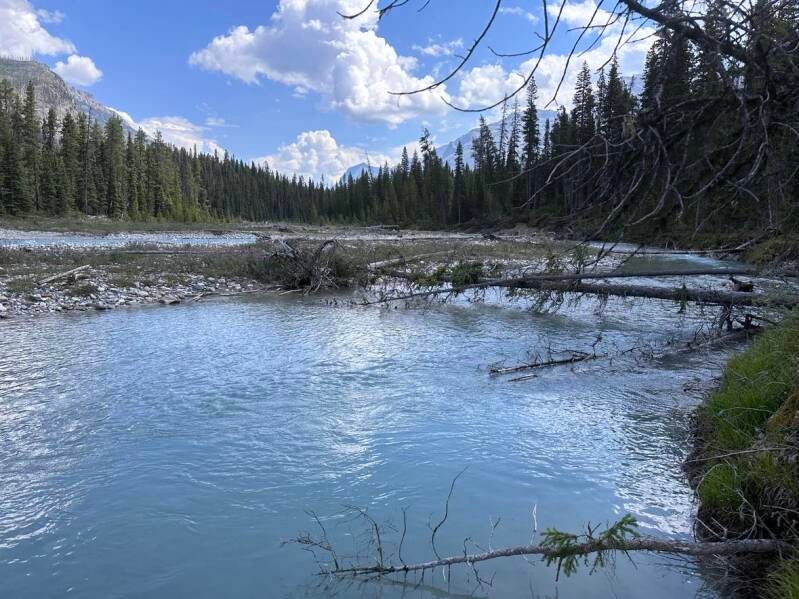
This area is a sacred spot where we go to "polar bear dive" each year. The traditional health team takes part in this event each year during the harvest because it resets the body. Think of it this way, for thousands of years we survived on Turtle Island without the use of Western medicine or prescription pills, we know for a fact that the earth gives us all that we need and without nasty side effects. for more information about cold water therapy look up Wim Hoff and know that you should only be doing this activity if you are healthy enough to get in there and always consult with a holistic care guide or doctor if you have any worries. We promote traditional health but do not ignore the medical field for the safety of our people.
Harvesting Plants is part of every Sturgeon Lakers Heritage
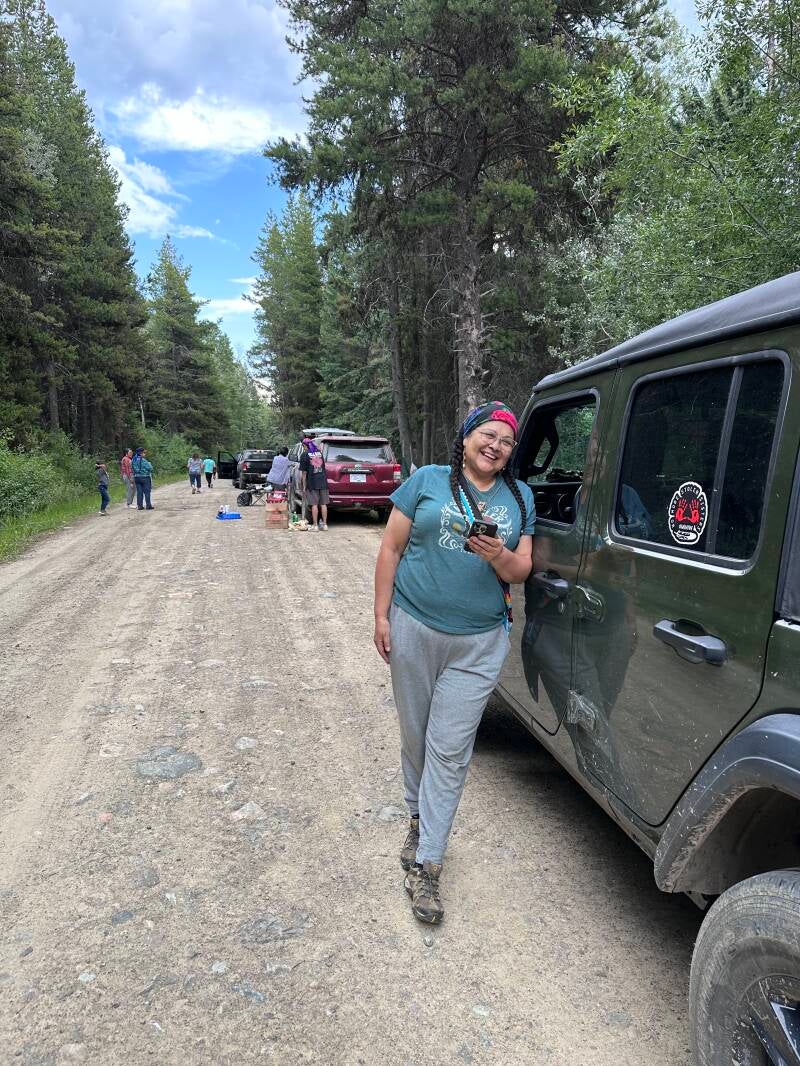
Above you can see my mom, Violet Naytowhow volunteering to pick with the SLFN health group for this 2023 season. We are high up in the mountains picking some roots that my moms dad (mosom) Andy Naytowhow, picked in this very same area 20 years earlier. We went together this year and we were very lucky to have the ok from our elder and healing lodge manager, Willie Ermine. The days were warm and the driving long, but always worth the blessings of the plants. Our youngest harvester was a tiny baby, often seen in her mothers arms keeping everyone's spirits very high. These areas are sacred and managed well to protect longevity and spiritual connection. This work is very hard even though in most pictures you do see us having a good time. It is a tradition of time immemorial. We are thankful to have this opportunity and hope to keep the traditions going forever!
Nehiyaw Place Names
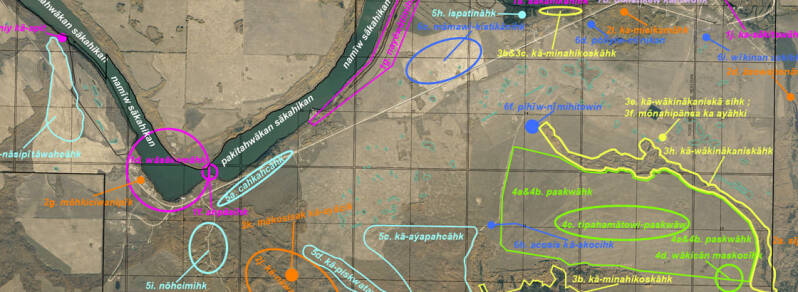
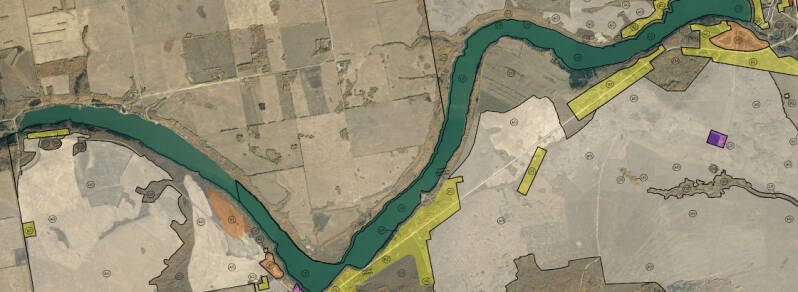
This picture indicates the Cree Names for all of the areas in Sturgeon Lake according to a report on our land management systems in 2012. The Sturgeon Lake First Nation hired Crosby Hanna & Associates to prepare a Land Use Management Plan that would be suitable for directing future land use and development on their home Reserve as well as on Treaty Land Entitlement Reserves. The plan is intended to harmonize economic development interests with local customs, traditional values, and respect for Sturgeon Lake lands. The Elders of Sturgeon Lake helped guide the plan’s development throughout the process and provided a traditional land use map that identified historically and spiritually important places on Reserve 101 in both English and Cree. Based on local traditions, the project outlined processes for plan alterations, public consultation, and enforcement.
Here are the translations from the online dictionary, if you know better translations of have more information please contact me and I will update the map!
1. namiw sakahikan - fishing area of the lake
2. pakitahwakan sakahikan - net setting area of the lake
3. nasipi tawahoahk - needs translation"
4. (2g.) mahkiciwanipik - needs translation"
5. (1d.) wasekamahk (or wasekamaw )- a still clear-water bay
6. (5a.) cahkahcahk - needs translation"
7. (11.) ahpasik- needs translation/not found in cree dictionary.
8. (5i.) nohcimihk - away from the water or road
9. (2k.) makosisak ka-ayacik -December-needs translation"
10. (2j) la-nawa (partial word) - needs translation
11. (5d.) ka-piskwatan (partial word)-
12. (5c) ka-ayapahcahk- rugged area
13. (5h) ispatinahk -the hilly region: ispatinaw (corrected)
14. (6c.) mamawi-kisitikanihk -all together (needs translation)
15. (3b. and 3c.) ka-minahikoskahk - (prerverb, for it to be a pine forest) ka-minahikoskâk (corrected)
16. (21) ka-misikamahk - for the lake to be large, ka-misikamâk (corrected)
17. (6d) pokohtinikan - Seed or pakitinikan (corrected spelling)
18. (6f.) pihiw-ni mihitowin - place away from shore, needs more translation
19. (4a & 4b) paskwahk - a big meadow
20. (4c) tipahamatowi-paskwaw - The Treaty Grounds
21. acosis ka-akocihk - little arrow place to hang or be suspended
22. (3b.) ka-minahikokahk - need help
23. (1j) ka-sak- (NM)
24. (6i) wikinan - askih - (NM)
25. (2d.) asow - (NM)
26. (3e) ka-wakinakaniska sihk -need help translating
27. (3f.) monahipansa ka ayahki - A Well or storage of water, mônahipânisa, (Corrected)
28. (3h.) ka-wakinakananiskahk -
29. (4d) wakican maskocihk -
30. (3b. ) ka-minahikoskahk -minahikoskâw (pine grove)
History & Heritage
The Voices of our Nation Project
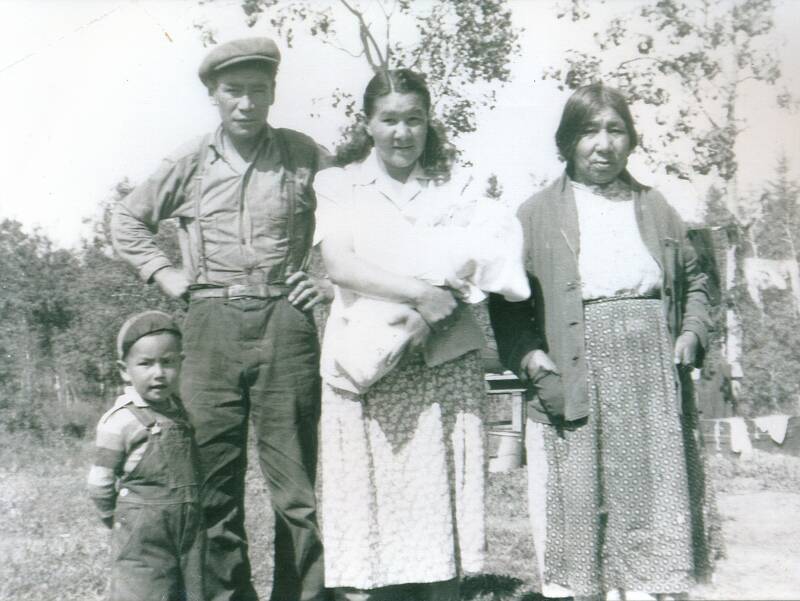
Coming Soon! The "Voices of our Nation project" is a historical project where we collect historical pictures and documents and digitized them for our community. This fall we plan to create recordings of elders stories to go with each photo so that we can share our history orally through this website. Many of the pictures that you see today in heritage centers do not incorporate this local narrative and we are blessed to have the stories that are related to these photos be shared with the soothing voices of our nation. The full project will also be available on our youtube channel. I would encourage all First Nations to begin projects like this as we lose more history every day.
The Indigenous History and Heritage Gathering Report
Written by Lillanohna Naytowhowcon, Ba Archaeology, Community Research Assistant SLFN
A New Way of Looking into the Past: The National Centre for Truth and Reconciliation (NTCR) and the First Nations Confederacy of Cultural Education Centre’s (FNCCEC) hosted this event and was supported by “Know History”. Know History is creating relevant historical documentation for first nations, link here: Know Indigenous History (knowhistory.ca) . The conference had a wealth of knowledge and community tools that are going to be useful in the work we are doing in Sturgeon Lake First Nation like: mapping, archaeology, and historical documentation/digitization. The conference was attended by community members who are doing FN history and heritage projects which include commemorative histories, renaming projects, historical claims, and the search for missing children and unmarked burials associated with residential schools.
SLFN has taken part in ground penetrating radar where we have found the 6 unmarked graves of our previous chiefs from the 1800’s which is a commemorative project as we planned to celebrate this site at an event this year 2023, the renaming of our local areas and use of the Cree language in our signage after the construction of our new paved road, historical claims and the “cows and plows” agreement. The TRC has concluded that all First Nations should be pushing to have access to all documentation related to our history. We are creating history by stating the truth of our past and doing reconciliation work for a better future.
My experience at the conference
When we arrived in Ottawa we watched a speech by Claudette Commanda, who is the CEO of FNCCEC. Claudette has been promoting First Nations for 35 years and is a professor at the University of Ottawa. She started out the welcoming ceremony by speaking about the importance of writing down your notes on a napkin because the funding promises between Canada and First Nations were written on a napkin and preserved by early Canadians as lawful documents. She went on to discuss the impacts of colonialism which were a destruction of our native ways. Pre-contact Indigenous people had their own forms of housing, farming, child rearing, medicine, healing, therapy, government, culture, society, and more… that mainly worked with nature and not against nature to survive. This is very evident in the way that settlers did not see the environmental impacts on the land from First Nations occupation of the land. This knowledge was such a well understood and vital part of First Nations lives that they did not have to write it down but simply taught it as common knowledge within their homes and lodges as everyone’s communal roles were completely understood in the indigenous way of life.
Colonialism invaded our territories and waged war on every aspect of native ways of life by trying to assimilate First Nations to a European way of life because they presumed it to be superior and thought of First Nations people as less than human. The day schools, residential schools, child, and welfare systems and now group homes are all modes of “saving the child and killing the Indian” (Pratt 1892). This mode of work was set into motion in the United States and Canada in the 1800s under that pretense. We are finding out more and more about First Nations pasts through the stories that are told that expose the truth behind these so called “schools” which were more likened to work camps and factory worker institutions. The lived experiences of the students, which has come in the form of over 10,000 testimonies about the schools and workers have been devastating for our leading professionals who work in these fields to read.
It is those experiences that have the National Center of Truth and Reconciliation working hard to get the names of every child that went to residential schools and day schools put into a national database so that survivors and supporters can find their relatives. It is our duty as Indigenous experts and professionals to learn what we can and share it with our communities so that they can have all the tools and opportunities they need to help find our relatives and promote ourselves as First Nations in a good way. Sharing has been the spirit of intent for Indigenous people and was the main goal when we the treaties were made. This should always be repeated when we are talking about the past. It was never a decision to give up the land but to share it. Claudette is doing amazing work and you can look up more about her and the other speakers on the IHHG website, link here: Indigenous History & Heritage Gathering (ihhg.ca).
The Executive Director of the NCTR, Stephanie Scott gave us a recap on what is going on at a high-level scale when it comes to First Nations Record keeping in Canada. There are currently 5 million digital records of First Nations being kept by the NCTR which have been collected from the Government of Canada. The NCTR is also working on getting 10 million more records because the government must scan their records for information before they give them up to the NTCR. The government has a terrible record keeping history and it was mentioned that the worst record keeping institution to date is the department of Indian affairs. The NCR is consistently fighting to get documents and consistently runs into bureaucratic issues when it comes to Indigenous people and entities being able to view their government logs and saved documents. The NCTR is aiming to create a database that is easy to use and accessible to all First Nations across the country for generations to come.
Unmarked Burials
Keynote speaker Kimberley Murray is the Independent special interlocutor for missing children and unmarked graves and burial sites associated with Indian residential schools. She is a member of the Kahnesatake Mohawk Nation and an expert in unmarked burials. She has been dealing with a multitude of issues which are mainly in the department of historical record keeping and the bureaucracies that deny First Nations access to records. The guiding principles of unmarked burials reads:
1. Spirits and bodies must be treated with honor, respect, and dignity because this work is sacred.
2. Survivors must be honored and acknowledged for raising public awareness about the truths of unmarked burials of children who died in residential schools.
3. The victims of mass abuse deserve to know what happened to their relatives that dies in schools and churches.
4. These projects must be governed by our laws and protocols because they are different from nation to nation.
As First Nations people we must state our law and protocol related to the burial, recovery and acknowledgement of First Nations children in residential schools. I would add on "all of our relations" which are currently being stored away.
The searches and investigation must be done using the truth. Using testimony and records of forced transfer. Children were forced and traded between institutions that leads the records to not only include residential schools but also hospitals, Indian hospitals, training schools, and many other institutions. There is a can geo map that you can discover, which documents the burial sites associated with residential schools. Unmarked Burial Sites Associated with Indian Residential Schools – Paths to Reconciliation (canadiangeographic.ca) Searches are happening in locations which were not previously thought of, as the government not only moved institutions but forced the transfer of children in between institutions. 147 residential schools are recognized and recently, 1531 other institutions were added to the places of significance where children were sent as 9000 people came forward to reveal this truth about children being forcibly transferred in between institutions.
The IHHG asks that EVERYONE reads the TRC final Report. The TRC wants Canadians to know the truth and learn the history of this nation. The TRC is currently undergoing systematic research into how the children died in these institutions. 3200 children’s deaths were documented, and we are nearing a number above 10,000 unmarked burials found and rising. We still do not have all the records and testimonies that are related to these cases. The TRC found that 15 tons of paper, 200,000 Indian affairs records were destroyed before they could be investigated. The TRC believes a moratorium should be placed on all records, being temporarily prohibited from an activity so that we may know the truth. These records can be destroyed in 2027 so we need to act now before they are gone forever. I would argue these records are a part of Indigenous history and should never be destroyed.
Indigenous History & Heritage Management
It is inherently our job to supervise the correction of history written about First Nations and not by First Nations. It is a job that requires the co-operation and the support of the Canadian Government and institutions that recorded the lives of First Nations people. The historical records written by European entities are a part of First Nations history and heritage, therefore cannot be kept in vaults and only visible to non-indigenous people. The era of residential schools will always be a part of our history and the people are demanding to know the names, locations and families that were involved with this era of assimilation. First Nations are also interested in knowing where the number “150, 000” came from in context with residential school survivors. It is a human right to know about our lost relatives and is also seeking to have access to medical files, police reports, photos, death certificates, transfer records, ICFS records and all institutional records dealing with First Nations people. We live in a digital world where these files can now be digitized for safe keeping, forever. The management of Indigenous documents needs to become a part of all organizations that currently have access to these files. From the information shared by keynote speaker, Kimberley Murray, this is an ongoing project that will take decades to complete, not a few years as suggested by the Government of Canada. We have a lot to do in catching up with out data systems and data collection when it comes to First Nations records and record keeping.
The record keeping practices of Indian affairs, and the 10 other names this department was given over its existence, did not do a very good job of maintaining First Nations records. In my experience a case related to this topic happened in Sturgeon Lake First Nation this past year in 2022. A record book from 1887 was found in the basement of our high school which contained all the signatures of our first settlement which included the Cree names of our ancestors (as best as the Indian agents could spell Cree words). This was very valuable to us as a nation because we could read our ancestors original Cree names, as names like mine (Naytowhow) are shortened and misspelled versions of what they originally were. We also need to keep in mind that Cree naming was not a “first name-last name” style until the making of the treaties, but we can trace people and find them in the records as ancestors because of the introduction of this naming style. The misspelling and pronunciation of these names have eventually lost their origins and original meanings to many First Nations people, and we can now trace back those meanings. These types of documents are important to the history and heritage of First Nations people in Canada because they show our relationship with the land and the past. Although it is our past, we have never quite had any control of it.
Historic Claims: History on Trial
Moderator: Brenda Gunn
Speakers: Bruce McIvor, Jean Teillet, Hon. Leonard S. Tony Mandamin
The law in Canada has not changed since the 1700s. If a lawyer came to court from the 1700s and stood in our courts today, they would be right at home. The law in Canada is designed to protect the king at its core. Crown property is designed to give the King full access to all lands. The law was originally created to protect Canadian men of a particular class. The government is a reactionary system and is not designed to “do things” but is made to protect the government. The speaker states that in Canada the government treats First Nations as a race and not a nation. We are nations of people with our own governance. The reason behind treating a group of people as a race rather than a nation is that races do not have rights. This is proven by the existence of “The Indian Act” which is a racist federal document. The Indian status card is racist, what other person in the world walks around with a literal race card? The key to our future is the acceptance of our Nations. Maybe in the future we will have a nation card, you know, like a passport.
The judicial system is created to protect property and not trained to understand history. That flows into a new question of how do we understand history? Not only must we question what was written but why was it written and by who? There was always a purpose to writing when we look at the past. For instance, the TRC has reported that in some cases the priests would bump up the numbers of students in the schools because if there were more students in the schools, they could get more priests working with them at the schools. Things like this may account for some of the falsification of numbers when it comes to the number of children that were attending the residential schools and churches. Our job now is to analyze the documents that exist and to promote adversarial questioning. Our current justice system only works by looking at the facts. We also can benefit from using anthropologists to analyze documentation as they will not only see what is on the pages of these documents but look at the reasons why the documents were made and who they were written by. This is why we do not want to adjudicate history or to mandate history because history can change and evolve over time with new documentation and new information being added as time goes on. A case study was reviewed at this time looking into the Williams Treaty in the 1700’s which had promised the rights of hunting and fishing. This right was taken away in the 1900s, so a case was brought to court. In 1992 the government was challenged and lost this case due to an anthropologist proving how important fishing was to the community and the settlement relied on the idea that there was no possible way that the band would have given up their rights to fish because of that fact. In conclusion we are not to assume that judicial proceedings are the only types of documentation worth weight in a trial, and it is our job to continue to question.
How were the records managed?
During the colonial period records were drawn from a variety of colonial institutions and not always from the “Indian Department”. There was a register-docket-letter book system where letters could be sent and replied to. After this period was the post-confederation period where the DIA controlled the records about Indigenous-Crown Relations which included: legal, social, economic, and cultural information. There is 1. central numeric filing system with incoming and outgoing correspondence at headquarters but with a “subject extension registers” (Red and Black series) and 2. A Duplex numeric system is a subject based system where records were reorganized and grouped according to specific subjects. This information can be found on the Crown Indigenous Relations and Northern Affairs Canada Website.
Canada has a wealth of First Nations records. There are 268 years of record keeping that include the estates of dead people, band governance, and even the types of things that were not allowed in Native communities during the first appearance of the Indian Act.
The main creators of these records were Indian Affairs. Here is a list of the departments in charge of Indian Affairs over time:
British Indian Department (1755-1860)
Secretary of State of Canada (1860-1869)
Secretary of State for the Provinces (1869–1873)
The Interior (1873–1880)
Indian Affairs (1880–1936)
Mines and Resources (1936–1950)
Citizenship and Immigration (1950–1965)
Northern Affairs and National Resources (1966)
Indian Affairs and Northern Development (1966–2017)
Indigenous Services (2017–present)
Crown-Indigenous Relations and Northern Affairs (2017–2018)
Crown-Indigenous Relations (2018–2019)
Crown-Indigenous Relations and Northern Affairs (2019–present)
Departments responsible for Northern Affairs:
The Interior (1873–1936)
Mines and Resources (1936–1950)
Resources and Development (1950–1953)
Northern Affairs and National Resources (1953–1966)
Indian Affairs and Northern Development (1966–2017)
Crown-Indigenous Relations and Northern Affairs (2017–2018)
Intergovernmental and Northern Affairs and Internal Trade (2018–2019)
Crown-Indigenous Relations and Northern Affairs (2019–present)
Links: Federal Departments of Indigenous and Northern Affairs | The Canadian Encyclopedia
Here is a startling fact: In regional offices, Indian affairs had no storage for their documents until 1950.
At this time there was a central filing facility, but that facility also caught on fire around this time and thousands of documents were lost.
The fact that we have reports at all can be attributed to the following people:
- Lawrence Vankoughnet, Deputy Superintendent General in 1882.
- Duncan Campbell, Nova Scotia’s Chief Accountant 1890.
- Hayter reed, 1895.
These Indian agents wanted to show how well they had assimilated Indigenous people and they took meticulous notes of their experiences. This is why an anthropological analysis of historical writing is essential in today’s research. Readers need to be conscious of who was writing and why they were writing. If the end goal was to highlight the endeavors of Indian agents, we can assume that First Nations people were not written about in an honest or positive light. This is like the present-day newspaper, when headlines show other countries or nations in dim light or less than favorable conditions to promote the writer’s opinion. It is a short form of propaganda which was heavily used in the beginning of the colonial period in North America. If you paint the people as less than human than you can treat them poorly (in a western view from the 1700s). We know that First Nations have respect for all things, this way of thinking would not have made sense to the settlers at the time because their main belief was capitalism. When you view the world in an anthropological lens the written word is not always the best or more superior way of seeing things. For years it has been argued that oral history is not as good or correct as written history but if that were true than there would be a holistic view of history which includes all people equally telling their stories. We now live in a world where that is possible. What a great time it will be when we acknowledge all ways of knowing and understanding the past.
Keynote Speaker: Tanya Talaga
Award winning Anishinaabe journalist, speaker, and filmmaker. Tanya speaks about the lasting impacts of residential schools and the path forward.
Books:
All Our Relations: Finding the Path Forward by Tanya Talaga | Goodreads
The records that Canada has about our past have been hidden, wrong and kept. First Nations have been “othered” in their own lands and it is time for them to tell a story of their own. She explains that you never know what relatives you will learn about as you grow up and she was faced with meeting a relative that never made it home from residential school. His name was Thomas Skilleter and he attended Shingwalk School until 07/12/1913. In the census records of this student, Thomas was referred to as an “inmate”. That is a clear look at how the children were viewed when they went to these schools. We need to be wary that the records may even miss-name and miss-gender the kids who went there. Thomas had a little brother who also went to the same school and his name was Sam Skilleter, but if you were to check the records, he would have been named Sarah. Physically moving the institution was also an issue so when we are trying to look up the records of residential school it is also important to look at any building plans and blueprints. Tanya also shows examples from the Indian Agents notes that show how ill they spoke of First Nations children and says, “there was no love for children”. The Indian agents spoke about dirty habits, animism, and the generalities of their lives but you would never hear them speak about a child’s interests or hobbies. Often the children were not even spoken about by name but as inmates. Sadly, Sam died of typhoid fever before his 18th birthday and neither brother made it home. We have a right to know what happened to our relatives and the NRTC is working to develop a database of all First Nations children that were institutionalized.
Tanya also mentions the Popal apology that was suggested by the TRC. The pope apologized in 2022 at the Largest residential school in Canada. Here is the original apology and video of the event: 'I am deeply sorry': Full text of residential school apology from Pope Francis | CBC News . Pope Francis stated at this event, “An important part of this process will be to conduct a serious investigation into the facts of what took place in the past and to assist the survivors of the residential schools to experience healing from the traumas they suffered.” It is evident that the Government of Canada and all ties to European institutions like the Vatican need to be a part of this investigation. Tanya says that the Vatican Museum has a large collection of pre-contact First nations artifacts that need to be viewed by First Nations people. The future of reconciliation includes the repatriation of Indigenous artifacts. We need to seek protection of Indigenous artifacts because they are a part of our history and heritage.
Museum mandates in Canada and Europe are to collect and keep what they have forever for documentation and for research. First nations would benefit from having a center for the storage and viewership of First nations artifacts. It has been far too strange to walk into a museum and see First Nations artifacts placed beside dinosaur displays. It is also uncomfortable knowing that some of these places are holding ancient Indigenous knowledge that comes in the form of a pipe and bundle. There are protocols related to these materials and the many stolen or collected Indigenous artifacts that are scattered around the world. For instance, in the northwest coast of Canada we have tribes that have had totem poles stolen by the Smithsonian institution for storage and viewership in Washington D.C. The correct way to handle the totem pole is allowing it to disintegrate into the ground where it was originally placed, continuing the cycle of life, death, and decay. That is part of First Nations management in history and heritage. The handling of artifacts can be conducted by our elders and the repatriation of artifacts needs to become a policy in Canada. There are also no laws that protect Indigenous artifacts or remains in Canada. There is a 1992 museum policy that exists but does not legally protect First Nations remains and artifacts. This is why we question whether museums can be trusted with First Nations history and heritage, because as mentioned before, the law was not designed to protect First Nations people. It is reactionary and needs to face dilemmas to make changes. Cultural patrimony is not recognized by copyright either, which means that copyright cannot protect communal artifacts. In essence, the museum is a colonial system, and we cannot use the same policies, terms, and rules of that system to perpetuate our own way of life. Adopting systems that already exist is assimilating so it is best that we develop our own policies, spaces, and rules when it comes to our history. The health and safety of First Nations comes first on all these fronts. We need to strengthen the commitment of reconciliation in our own ways. There needs to be accountability, shared authority and access to our records and artifacts. We need Indigenous led heritage and history work that makes laws such as a repatriation act and an act likened to NAGPRA in the United States. We need networks online of our history and heritage that connects Nations, professionals, experts, and our people. We need safety and protection in the public and private sectors related to these sensitive subjects. We need cultural propriety in copyright laws. We need sacred and ceremonial policy to protect our data from being stolen and direct consequences for the breaking of those policies. We need databases, native networks and servers that are based in Canada to protect our files. The law is inequitable and does not hold up our sovereignty. It is time for First Nations to take control of their own destinies by having a clear view of the past.
Create Your Own Website With Webador